
SINGAPORE, September 20, 2026 : Climate action in Southeast Asia must move faster, go deeper into communities and remain anchored in justice if the region is to respond meaningfully to rising climate risks, according to Aimee Oliveros, Branch Manager, The Climate Reality Project Asia.
Speaking to CarbonWire for the Climate Dialogues series on the sidelines of the recently concludede Climate Reality Leadership Corps Training in Singapore, Oliveros said the gathering came at a crucial moment for Southeast Asia, a region that includes some of the world’s most climate-vulnerable countries.
“Climate action is needed now,” she said, adding that the Singapore training was taking place 10 years after the last such training in the Philippines. “This is a movement that needs to happen now. It is urgent. It has to be rooted in justice.”
For Oliveros, the significance of the Singapore training lies not only in the sessions themselves, but in the effort to build and sustain a regional network of climate leaders. She described Asia as being in a decisive decade for climate action, with The Climate Reality Project Asia seeking to harness the power of communities across the region.
Training as a Catalyst for Regional Climate Leadership
The Climate Reality Leadership Corps Training in Singapore brought together participants from across Southeast Asia at a time when the region is confronting rising temperatures, extreme weather events, energy transition pressures and growing questions around climate justice.
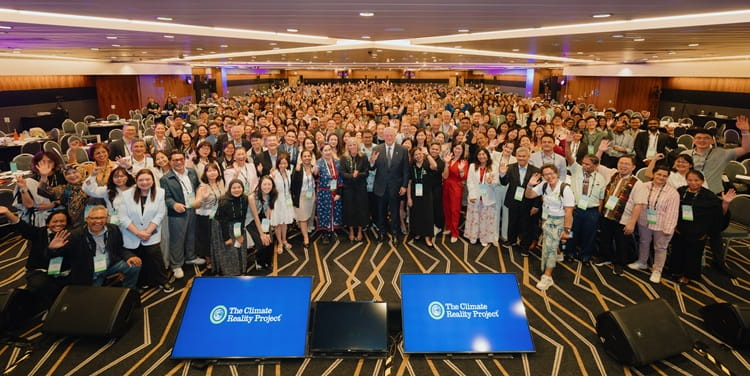
Oliveros said the training was designed to leave participants energised and equipped to act.
“You always come out of this training feeling very inspired,” she said, noting that former US Vice President Al Gore and The Climate Reality Project aim to give energy and power to people and communities so they can find solutions and opportunities for action.
She said every such training helps participants find a community, something she described as particularly powerful given that this was the first Climate Reality Asia training being conducted again in Asia after a long interval.
That community dimension is central to the organisation’s strategy. Rather than treating climate action as an individual or isolated national effort, Oliveros said The Climate Reality Project Asia is seeking to connect climate leaders across Southeast Asia into a wider movement.
City-Based Hubs Across Southeast Asia
A major next step for The Climate Reality Project Asia is the development of city-based hubs.
Oliveros said the organisation is looking to build these hubs in the Philippines, Malaysia, Singapore and Indonesia, allowing local climate actions to emerge from communities while being connected to global impact areas. These include reducing emissions, financing the just transition and promoting global climate leadership.
The idea is to move beyond country-by-country activity and build a regional community that works as part of a global network.
“We’re not operating as per country now,” Oliveros said. “We’re working together as a community, as a global network.”
The approach reflects the reality of climate risk in Southeast Asia. While each country faces its own vulnerabilities, many of the region’s climate challenges are shared. These include energy transition needs, financing gaps, adaptation pressures, urban climate risks and the need to ensure that workers, low-income communities, young people and vulnerable groups are not excluded from climate solutions.
Oliveros said the work being done in the region must always be rooted in justice.
Community Power, But Not Community Alone
Oliveros emphasised that community-led action does not mean communities acting alone.
Climate action, she said, has to be multi-sectoral. It must bring together governments, academia, youth, the private sector and local communities.
“There’s always power in the community that we are building,” she said. “It’s always learning together and working together.”
The organisation has seen such approaches before in the Philippines and other branches, and now wants to harness that experience across the wider region. The shift from national activity to regional collaboration, Oliveros suggested, can make the movement more powerful.
This is especially important in Southeast Asia, where climate vulnerability intersects with dense urban centres, economic inequality, exposure to extreme weather and uneven access to resources. Community action can give voice to local realities, but policy and systems change require institutions, businesses and governments to be part of the process.
The term just transition is now widely used by governments, businesses and civil society, but Oliveros said for The Climate Reality Project Asia it has a direct practical meaning: not leaving anyone behind.
“For us, it’s really not leaving anyone behind. Everybody has to have a seat at the table,” she said.
That means affected communities should be part of policy development, their voices should be heard, and they should have the space and opportunity to speak up. Oliveros linked this to education, community action and the ability of people to understand their vulnerabilities and identify ways to address them.
For Southeast Asia, this framing is important because the energy transition will affect workers, low-income communities, urban residents, young people and communities dependent on existing industries. A transition that reduces emissions but excludes vulnerable groups would not meet the justice test that Oliveros described.
The focus, she said, should be on finding people, building networks and understanding specific vulnerabilities so that climate action can respond to real needs.
What the Hubs Will Do
The planned city hubs are expected to anchor their work around The Climate Reality Project’s global impact areas: reducing emissions, financing the just transition and global climate leadership.
Oliveros said the hubs will develop specific actions within cities, amplify local voices and ensure participants are equipped and engaged. Sustaining the community after the training will be central to keeping those efforts alive.
The organisation is also looking to build regional networks on specific themes. Oliveros mentioned a network on energy, the first such effort in Asia, and another on finance. These networks are intended to create platforms that climate leaders and communities can plug into across the region.
This thematic network approach could be significant. Energy and finance are two of the most important levers in Southeast Asia’s climate transition. Energy systems remain central to emissions reduction, while finance will determine whether countries and communities can afford a transition that is fast, fair and inclusive.
Working With Governments and the Private Sector
Oliveros said climate action requires stakeholder engagement across sectors, including local governments, national governments and the private sector.
“This work really has to entail a lot of stakeholder engagement,” she said.
She cited the Green Energy Option Program in the Philippines as an example of work involving private industries and local governments in the transition to renewable energy.
She said similar efforts are relevant across the region, especially where countries are trying to identify voluntary mechanisms, build collaboration and understand how transition pathways can be integrated into different national contexts.
For Southeast Asia, this multi-stakeholder approach is critical. The private sector is a major emitter, investor and technology adopter. Governments shape policy and incentives. Communities bring lived experience, local legitimacy and pressure for accountability. Civil society can help connect these actors and ensure that climate action does not become a top-down exercise detached from real-world impacts.
Keeping Climate Leaders Engaged After Training
One of the challenges for any large climate leadership programme is sustaining momentum after the event ends.
Oliveros said The Climate Reality Project Asia uses several platforms to keep climate leaders engaged. These include Reality Hub, an internal communications platform, along with community meetings, town halls, learning sessions and engagement activities.
She said the network currently has around 4,000 members and, with leaders joining from the Singapore training, is now close to 5,000.
For Oliveros, engagement has to be continuous and part of a cycle of improvement. The organisation wants to keep creating opportunities for climate leaders to gather, learn and move the needle.
This continuing engagement is important because climate action is not achieved through one-off training. It requires repeated mobilisation, peer learning, collaboration, local projects, advocacy and the ability to convert inspiration into sustained action.
Communicating Climate Without Fatigue
Climate communication remains one of the hardest challenges for advocates, media platforms and civil society organisations. The science is clear, but public action is often uneven, and climate messages can easily create fatigue, fear or helplessness.
Oliveros said the answer lies in storytelling, truth and inspiration.
“The beauty of Climate Reality is always the power of storytelling,” she said. “From storytelling, there comes inspiration.”
She said climate communication must speak about the reality of despair, but also about the possibility of action. Whether the audience is youth, communities or people in positions of power, the goal is to inspire change rather than leave people feeling powerless.
She also emphasised the importance of truth in climate communication, saying it must be present to amplify the work being done.
For CarbonWire, this is a critical insight. Climate journalism and communication must convey urgency without paralysis. It must show risk, but also agency. It must present data and science, but also voices, stories and pathways for action.
Singapore as a Regional Climate Platform
Although the conversation focused on The Climate Reality Project Asia’s work across Southeast Asia, the choice of Singapore as the location for the training carries broader significance.
The training brought together climate leaders from across Southeast Asia in a city that is increasingly positioned as a hub for climate finance, policy dialogue, sustainability innovation and regional convening. In Oliveros’ framing, the Singapore gathering was not only an event, but part of a wider effort to rebuild and strengthen regional climate leadership after a decade-long gap since the previous training in the Philippines.
The emphasis on city hubs in Singapore, Malaysia, Indonesia and the Philippines suggests that future climate action in Southeast Asia will depend on distributed networks, not only national policy frameworks. Cities will matter because they concentrate people, emissions, infrastructure, finance and climate vulnerability.
Oliveros’ core message is that climate action in Southeast Asia must be urgent, collective and rooted in justice.
The Climate Reality Project Asia is seeking to build city hubs, thematic networks, community platforms and regional collaboration that connect climate leaders across borders. Its focus areas, reducing emissions, financing the just transition and promoting global climate leadership, reflect the scale of the challenge facing Southeast Asia.
But the central thread in Oliveros’ argument is the role of people.
Communities must not be treated only as beneficiaries of climate policy. They must help shape policy. Workers, young people, low-income communities and vulnerable groups must have space to speak and participate. Governments and companies must be part of the solution, but the energy of the movement must come from engaged citizens and community networks.
As Southeast Asia enters what Oliveros called a decade of climate action for Asia, the region’s challenge is not only to accelerate decarbonisation. It is to do so in a way that builds trust, shares power and ensures that no one is left behind.